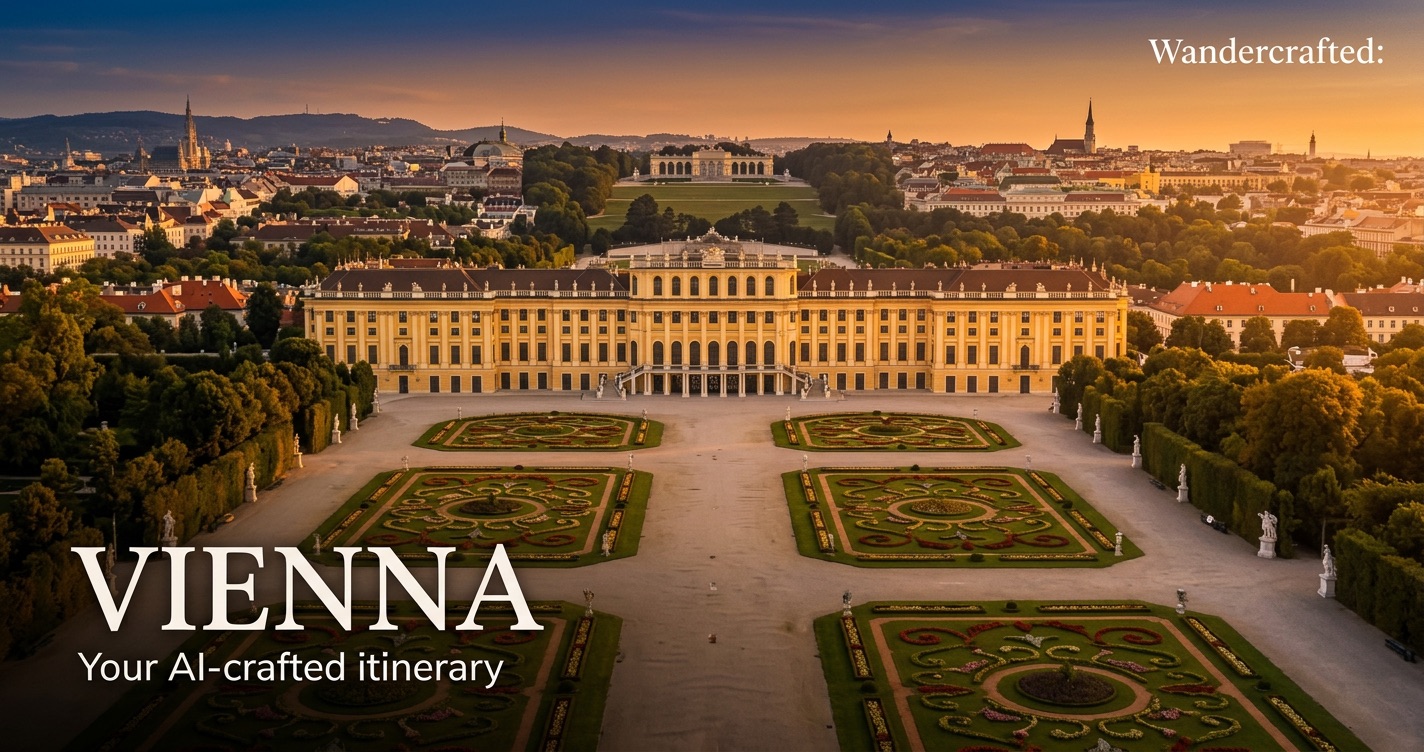
What a 5-day Vienna trip actually looks like
Vienna was once the capital of an empire that ruled half of Europe — and it shows. The Ringstrasse boulevard of monumental 19th-century buildings (opera house, parliament, art history museum) is unique in Europe for its completeness. Inside those buildings, some of the world's finest collections of art, music, and history.
Five days is a natural fit: enough for Schönbrunn, the great museums, a classical concert, proper coffee house sessions, and time to discover the less imperial side — the Naschmarkt, the Prater park, and the wine taverns in the Heurigen suburbs.
The Ringstrasse & Opera House
Schönbrunn Palace
Belvedere & Klimt
Coffee houses, Prater & Bratislava
Essential Vienna trip planning tips
Good planning makes Vienna feel effortless. Here's what actually matters.
Coffee house culture
A Viennese coffee house is a place to sit, think, and read for hours. Order a Melange (with milk), a Schwarzer (espresso), or an Einspänner (black coffee with whipped cream). You won't be rushed — ever.
Classical music is accessible
Standing tickets for the Vienna Philharmonic or State Opera start from €5–15. Book online (standing) at the last minute or queue. This is not an exclusive experience — it's priced for everyone.
Vienna City Card
The Vienna City Card gives unlimited transport and museum discounts. Worth it for a 3+ day visit. The U-Bahn is excellent — 5 lines covering the whole city.
Traditional food to try
Wiener Schnitzel (veal, not pork — the genuine article), Tafelspitz (boiled beef with vegetables), Sachertorte (the chocolate cake at Hotel Sacher), and Kaiserschmarrn (shredded pancake with plum sauce).
Museum passes
Vienna's museums are world-class and multiple. The Vienna Museum Cluster pass covers the Kunsthistorisches, Naturhistorisches, and affiliated museums. Worth it for 3+ museum visits.
Best season
May–June and September–October for ideal weather and crowds. December for the Christmas markets (genuinely magical — some of Europe's best). January–February for concerts and opera season at peak with fewer tourists.
This itinerary is just the starting point
Your Wandercrafted Vienna plan adapts to exactly how you like to travel. Tell it your preferences:
Vienna trip planning – frequently asked questions
Is Vienna worth visiting?
Absolutely. Vienna has a claim to being the world's most culturally dense city per square kilometre — the density of world-class museums, concert halls, and palaces within the Ringstrasse is unmatched. It also consistently ranks as one of the world's most liveable cities for quality of life.
How does Vienna compare to Prague?
Both are Central European imperial capitals, but different in character. Vienna is grander, more expensive, and more operatic. Prague is more intimate, more medieval, and significantly cheaper. They're 4 hours apart by train and many travellers do both.
Is Vienna expensive?
By Western European standards, mid-range. More expensive than Prague or Budapest, cheaper than Zurich or Paris. A mid-range hotel is €100–180/night, restaurant meals €15–25, and many of the best things (parks, the Ringstrasse, the Naschmarkt) are free.
How does Wandercrafted personalise my Vienna itinerary?
Tell us whether you're prioritising art and museums, classical music, coffee house culture, palaces and history, or day trips. The AI builds a specific day-by-day plan with concert booking advice, opening times, and restaurant recommendations across all budgets — adapted to your travel style and pace.
Explore all destinations
Wandercrafted builds personalised day-by-day itineraries for hundreds of cities worldwide.