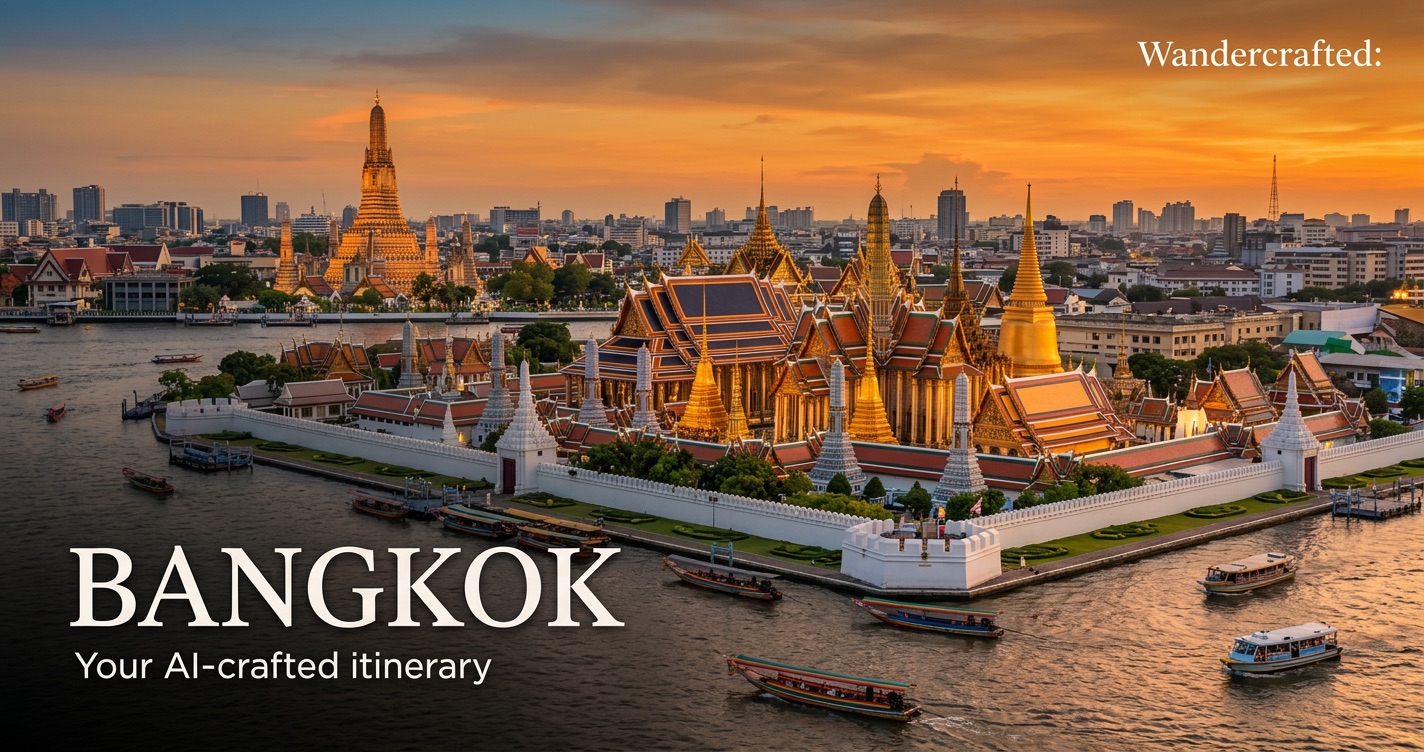
What a 5-day Bangkok trip actually looks like
Bangkok is one of the world's great travel cities — chaotic, sensory, impossibly generous with food, and full of quiet surprises tucked between the chaos. But it rewards the visitor who picks a neighbourhood and goes deep more than the one who tries to cover everything.
The sample below balances Bangkok's three main appeals: temples and culture, street food and markets, and the rooftop-and-cocktail version of the city. Your Wandercrafted plan shifts based on what draws you most.
Arrival & Sukhumvit
Grand Palace, Wat Pho & the river
Chatuchak, floating markets & street food
Jim Thompson House, shopping & your Bangkok
Essential Bangkok trip planning tips
Good planning makes Bangkok feel effortless. Here's what actually matters.
BTS Skytrain is your friend
The elevated BTS Skytrain covers Sukhumvit and Silom efficiently. The MRT covers the old town. For riverfront temples, use the Chao Phraya Express Boat — cheap, fast, and scenic.
Heat management
Bangkok averages 32–35°C year-round with high humidity. Schedule outdoor temple visits before 11am and after 4pm. Museums and malls provide mandatory midday refuge.
Temple dress code
Shorts and sleeveless tops will get you turned away from the Grand Palace and many temples. Lightweight trousers and a shirt fold flat in any bag.
Street food is safe
Bangkok's street food is world-class and safe. Busy stalls with high turnover and visible prep are your guide. Don't avoid it out of overcaution — it's the best food the city serves.
Tuk tuks
Tuk tuks are fun for short scenic trips — agree the price before you get in. For airport or long distances, Grab is dramatically cheaper and air-conditioned.
Mosquitoes and dengue
Dengue is present in Bangkok. Use DEET repellent particularly at dawn and dusk, especially near markets and the river. It's a manageable risk with basic precautions.
This itinerary is just the starting point
Your Wandercrafted Bangkok plan adapts to exactly how you like to travel. Tell it your preferences:
Bangkok trip planning – frequently asked questions
How many days do you need in Bangkok?
Three days covers the essential temples and markets. Five days lets you slow down, visit the floating markets, go deeper into the food scene, and not feel like you're rushing. Bangkok is also commonly used as a gateway — many travellers spend 2–3 days here as a start or end to a longer Thailand trip.
What's the best time of year to visit Bangkok?
November to February is the coolest and driest period — the tourist high season for good reason. March to May is hot and dry. June to October is the monsoon season — afternoon downpours but also lower prices, lush greenery, and manageable if you plan mornings outdoors and afternoons in.
Is Bangkok expensive?
Bangkok is exceptional value. Street food meals: 50–100 THB (£1–3). Sit-down restaurant: 200–400 THB. Mid-range hotel: 1,200–2,500 THB/night (£28–60). Even luxury hotels are substantially cheaper than equivalents in London or Paris. The main cost is flights, not the city itself.
How does Wandercrafted personalise my Bangkok itinerary?
Tell us whether you want temples and culture, street food and markets, rooftop bars and nightlife, or a mix. Set your pace and budget. Wandercrafted groups activities geographically (crucial in a city this large) and builds your specific Bangkok — not a route that sends you across town and back three times a day.
Explore all destinations
Wandercrafted builds personalised day-by-day itineraries for hundreds of cities worldwide.