What a 5-day Kyoto trip actually looks like
Kyoto has over 1,600 Buddhist temples and Shinto shrines, 17 UNESCO World Heritage sites, and the highest concentration of traditional Japanese culture anywhere in the country. It also has extraordinary food, perfect ryokan accommodation, and — if you time it right — empty streets at dawn.
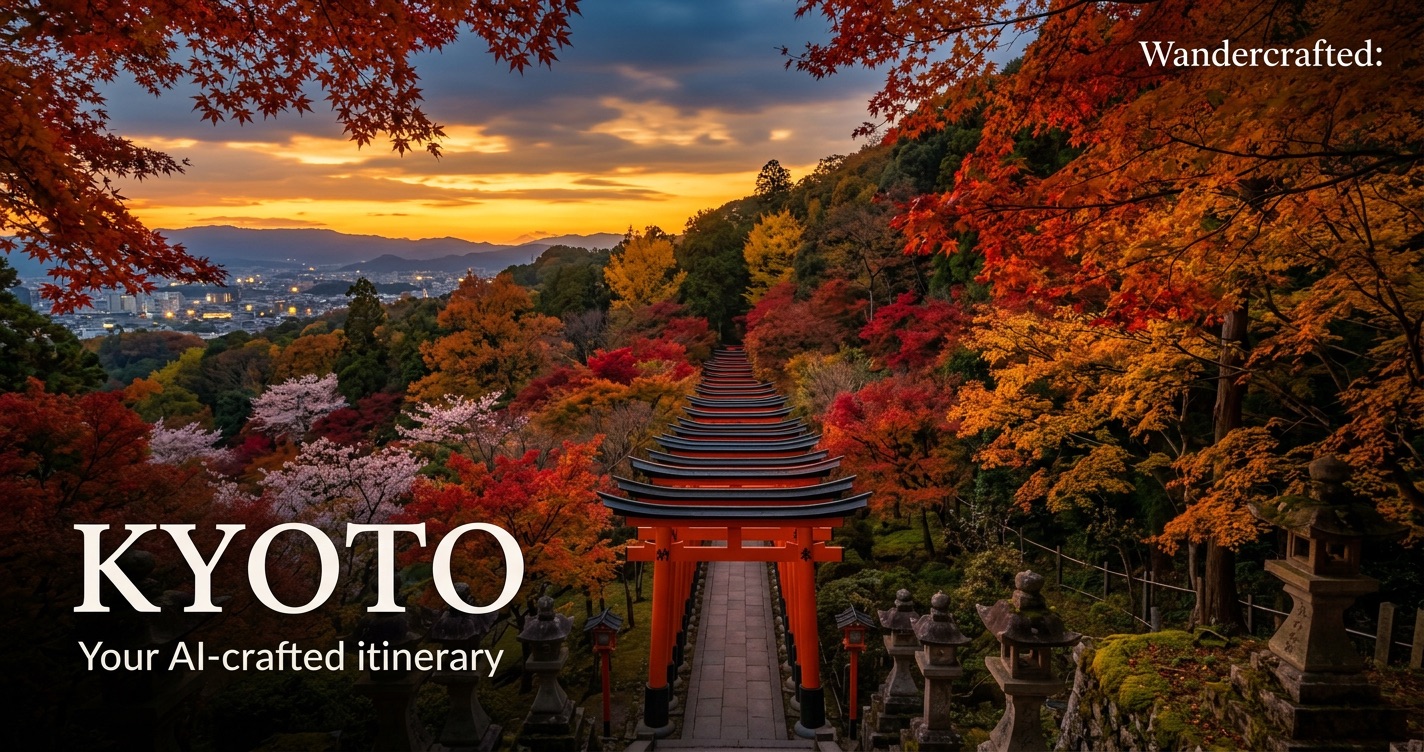
The challenge with Kyoto is crowds. The major sights are famous for good reason, but Fushimi Inari at midday and Fushimi Inari at 6am are completely different experiences. Your Wandercrafted itinerary builds around this — early mornings and crowd-free alternatives matter enormously here.
Arrival & Higashiyama
Fushimi Inari & Nishiki Market
Arashiyama: bamboo, monkeys & the river
Kinkakuji, Nijo Castle & your pace
Essential Kyoto trip planning tips
Good planning makes Kyoto feel effortless. Here's what actually matters.
Go early
Fushimi Inari, Arashiyama bamboo, and Kinkakuji are mobbed by 10am. The 6–8am window at major sights is transformatively different — quiet, beautiful, photogenic.
Bus vs walking
Kyoto's bus network is excellent and a day pass (700 JPY) covers almost everything. But the distances between Higashiyama, Arashiyama, and central Kyoto mean each area deserves a dedicated half-day, not an itinerary that zigzags.
Cherry blossom timing
Late March to early April — book 6+ months ahead as ryokan and hotels sell out entirely. Autumn foliage (mid-November) is equally beautiful and slightly less crowded.
Stay in a ryokan
A night or two in a traditional ryokan (Japanese inn with futon, kaiseki dinner, onsen) is one of Japan's signature experiences. Book ahead — small, quality ryokan fill up fast.
Tea ceremony
Urasenke and Camellia Tea Experience offer English-language tea ceremony experiences. Around ¥2,000–3,500, an hour long, and genuinely illuminating about Japanese aesthetics.
Cash, always
Many Kyoto restaurants, temples, and smaller ryokan are cash only. IC card (Suica or ICOCA) for transit. Keep ¥10,000–20,000 on hand — 7-Eleven ATMs accept international cards.
This itinerary is just the starting point
Your Wandercrafted Kyoto plan adapts to exactly how you like to travel. Tell it your preferences:
Kyoto trip planning – frequently asked questions
How many days do you need in Kyoto?
Five days is the sweet spot — enough for the major temple districts, Arashiyama, Fushimi Inari, and a couple of slower days. Three days covers the highlights if you're efficient. A week lets you add day trips to Nara, Osaka, or the Philosopher's Path in different seasons.
What's the best time of year to visit Kyoto?
Cherry blossom season (late March–early April) and autumn foliage (mid-November) are Kyoto's two iconic seasons and its most crowded. May, June, September, and October offer excellent weather with dramatically fewer tourists. Summer (July–August) is hot and humid but features Gion Matsuri — Japan's most spectacular festival in mid-July.
Is Kyoto expensive?
Kyoto is moderately priced by Japanese standards. A traditional ryokan with dinner and breakfast: ¥15,000–30,000 per person. Temple entry: ¥500–1,000 each. Ramen or soba lunch: ¥800–1,200. Budget ¥10,000–15,000/day excluding accommodation. The main splurge is a quality ryokan — which is worth every yen.
How does Wandercrafted personalise my Kyoto itinerary?
Tell us whether you're here for temples, food, traditional culture, photography, or quiet walks. Set your pace (Kyoto rewards slow travel) and group type. Wandercrafted builds a crowd-aware itinerary — grouping the eastern hills sights together, the Arashiyama area separately, and scheduling the most visited spots for their quietest windows.
Explore all destinations
Wandercrafted builds personalised day-by-day itineraries for hundreds of cities worldwide.