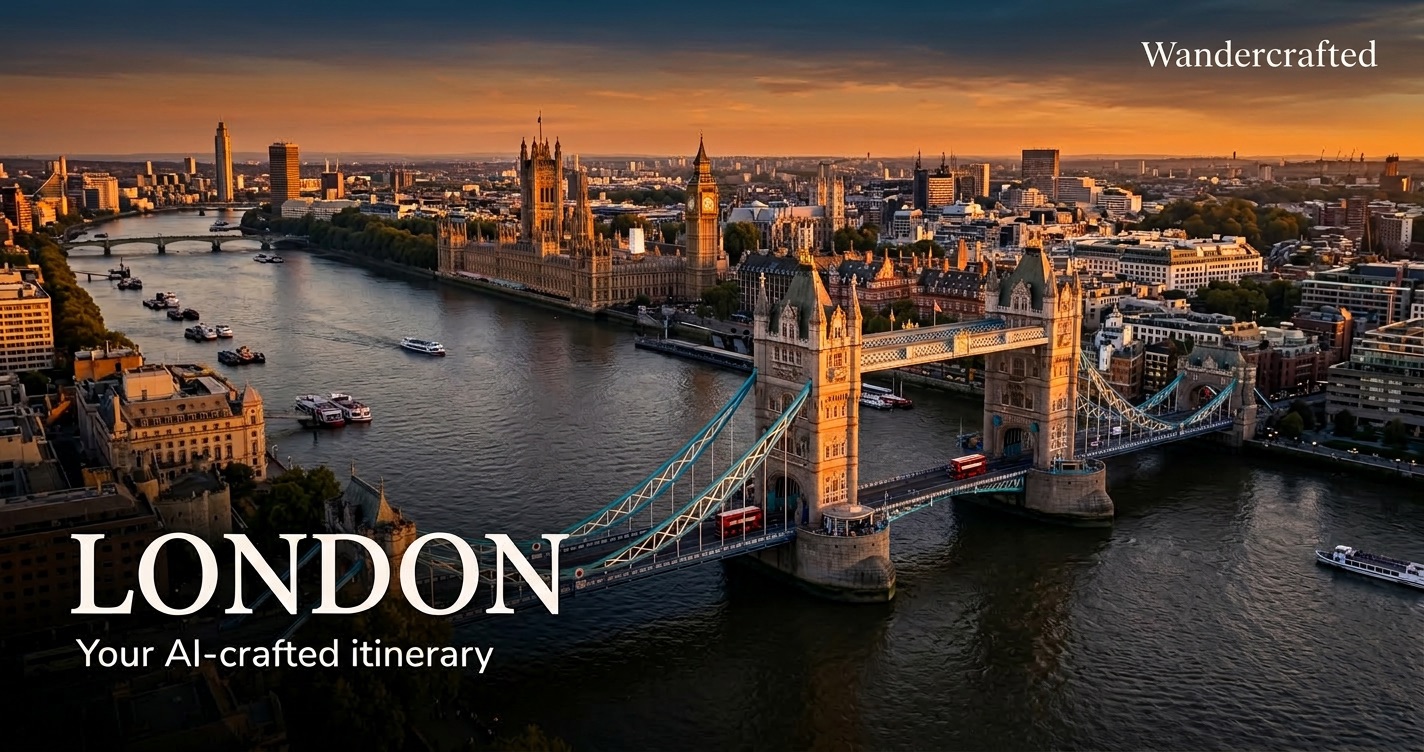
London is one of the most neighborhood-defined cities in the world. Unlike Paris, which is neatly divided into numbered arrondissements, or New York with its grid-based districts, London grew organically over centuries — village by village absorbing into the metropolis, each retaining its own distinct character. Where you stay in London doesn't just affect your commute times; it determines the kind of city you'll experience.
This guide covers eight neighborhoods worth serious consideration, with honest assessments of who each one suits. For a day-by-day plan with specific restaurant and activity picks, see our London 4-day itinerary and best food in London guide.
South Bank & Borough (Southwark) — The Culture Corridor
If Paris has the Left Bank, London has the South Bank — and it's arguably the single best base in the city for first-time visitors. The riverside walkway from Waterloo Bridge to Tower Bridge passes the Tate Modern, Shakespeare's Globe, Borough Market, the Shard, and Bermondsey Street, all within easy walking distance of each other. On a dry morning you can cover more world-class culture on foot here than almost anywhere on earth.
Borough Market is one of the genuine pleasures of London — a working food market that has been operating on this site for nearly 1,000 years, now surrounded by some of the best street food stalls and specialty food shops in the UK. Go on a Thursday or Friday morning before the weekend crowds arrive. Bermondsey Street, just south, is London's finest single restaurant street — Kiln, Flour & Grape, and a stretch of wine bars and galleries that feel miles from the tourist economy of central London despite being 15 minutes from Trafalgar Square.
Hotels on the South Bank range from large business chains near Waterloo (good value, excellent transport) to boutique spots near Borough. The area is a Tube stop from London Bridge station, connecting directly to Gatwick Airport — convenient for arrivals and departures without central London transfers.
Soho & Covent Garden (West End) — The Centre of Everything
Soho is London's engine room: a small grid of streets between Oxford Street and Leicester Square that somehow contains more restaurants per square metre than any comparable area in Europe. Brewer Street, Berwick Street Market, Old Compton Street, and the lanes around Carnaby Street offer an almost overwhelming density of good eating and drinking from mid-morning until 2am. The neighbourhood has historically been London's theatrical, LGBTQ+, music, and film district — the heritage is visible in every building if you know where to look.
Covent Garden is touristy in the central piazza but excellent in the surrounding streets. Neal's Yard is a tiny pastel-painted courtyard that's become one of London's most-photographed spots, and the lanes around Long Acre and Seven Dials contain some of the better independent shops left in central London. The Royal Opera House and the London Transport Museum sit within two minutes of each other here.
Accommodation in Soho and Covent Garden is expensive, but the convenience premium is real. You're within walking distance of the National Gallery, the British Museum, St James's Park, the South Bank via Waterloo Bridge, and every major West End theatre. Taxis and buses supplement the Tube in ways that make late nights genuinely easy.
Shoreditch & Hoxton (East London) — The Creative Quarter
Shoreditch is where London's creative industries chose to land when Soho became too expensive in the 2000s, and the resulting neighborhood is genuinely compelling. Brick Lane — London's most famous street market and home to the Bangladeshi community that has shaped east London for fifty years — runs north from Whitechapel into a stretch of vintage shops, bagel bakeries open 24 hours, and the Sunday market that draws half the city on a clear morning. Spitalfields Market, just south, has been a market of some kind since the 17th century; today it's covered and sells independent fashion, food, and art.
The street art in Shoreditch is world-class and changes constantly. The walls around Brick Lane, Hanbury Street, and the lanes off Bethnal Green Road function as an ever-rotating outdoor gallery. Dozens of the pieces are commissioned from internationally known artists; others appear overnight and are gone within a week. A morning wandering without a specific destination in Shoreditch is one of the best free activities in London.
The restaurant scene is among London's most innovative, partly because rents allow younger chefs to take risks that central London landlords won't permit. Lyle's, Brat, and St. JOHN Bread and Wine are all within walking distance. The nightlife extends from the rooftop bars of Hoxton to the clubs beneath the railway arches of Bethnal Green. The Elizabeth Line from Liverpool Street now connects Shoreditch to Heathrow in under 30 minutes.
Marylebone (W1) — The Sophisticated Village
Marylebone High Street has been voted London's best high street multiple times and it deserves the title. A single walkable strip from the DAUNT Books bookshop (one of the most beautiful bookshops in the world) north to Chiltern Street and beyond, lined with exceptional food shops, clothing boutiques, cafés, and restaurants that serve the wealthy residential neighborhood around them without being remotely ostentatious about it. It's the London you imagined before you arrived — Georgian townhouses, black taxis, and a cheese shop that takes its work very seriously.
The location is outstanding. Regent's Park is a five-minute walk to the north; the Wallace Collection (one of London's finest and least-visited art museums, free entry) is on Manchester Square; the BBC headquarters is on Portland Place. Baker Street, where Sherlock Holmes is memorialized in embarrassing tourist detail, is nearby if you have someone in your group who insists. More importantly, Bond Street Tube station puts you two stops from Paddington (Heathrow Express) and one stop from Oxford Circus.
Hotels here are expensive but hotels everywhere in London are expensive. Marylebone specifically offers better value than Mayfair and the Knightsbridge area while providing similar proximity to the Park and similar quality of restaurants. The boutique hotels on the side streets between Marylebone High Street and Baker Street are consistently recommended.
Notting Hill & Portobello (W11) — The Iconic West
Notting Hill has a reputation that runs slightly ahead of reality, partly because of the 1999 film and partly because Portobello Road Market is one of London's most famous destinations. The market itself is best experienced on Saturday mornings before noon: stalls selling Victorian silverware, antique maps, Edwardian jewelry, and eccentric collectibles alongside fruit and vegetable vendors who have been here for generations. The famous painted townhouses of Notting Hill line the adjacent streets in shades of pink, blue, yellow, and white.
The neighborhood shines in its restaurants. The area around Ledbury Road and Westbourne Grove has a concentration of excellent places — from The Ledbury (long one of London's best fine-dining restaurants) to the Lebanese and Middle Eastern spots on Edgware Road a few streets north. Electric Cinema on Portobello Road is London's oldest working cinema and still one of the best — armchairs and footstools, drinks service, and a consistently interesting programme.
In late August, Notting Hill hosts Europe's largest street carnival — the Notting Hill Carnival, a two-day West Indian cultural celebration that transforms the streets into one of the great party experiences on the continent. The rest of the year, the neighborhood is quieter and more residential, which is either its appeal or its limitation depending on your priorities.
Kensington & South Kensington — The Museum Mile
South Kensington is where London's extraordinary concentration of free world-class museums clusters together within a ten-minute walk. The Natural History Museum (with its dinosaur skeleton and free entry) immediately next to the Victoria and Albert Museum (245 permanent galleries across 5.5km of corridors), which connects via Exhibition Road to the Science Museum. This is one of the greatest concentrations of cultural institutions in any city in the world, and the free entry policy means you can spend a week here and never pay admission.
Hyde Park borders the area to the north, providing 350 acres of royal parkland including the Serpentine Gallery and the Serpentine lake. Kensington Palace — still a working royal residence — sits at the western end of the park. Kensington High Street has reliable chains and some better independent options; Kensington Church Street heading north has the antique dealers and the quieter café culture that characterizes the residential borough.
Hotels in South Kensington range from large Victorian hotels converted to good use to small boutique properties. The area is slightly removed from the nightlife of the West End and the food scene of east London, but for families with children and museum-focused travelers, the combination of access and accommodation quality is hard to match in London.
Hackney & Dalston — The Real East London
Dalston in particular is the neighborhood that Shoreditch was fifteen years ago: genuinely local, slightly rough around the edges, and home to some of the most interesting restaurants and bars in London precisely because it hasn't been polished for visitors yet. The Turkish community along Kingsland Road has produced some of the best restaurants in the city — mangal ocakbasi (charcoal grill restaurants) where the lamb chops arrive blackened and perfect, alongside köfte, lahmacun, and offal dishes that the rest of London hasn't caught up to yet.
Ridley Road Market is Hackney's version of Borough Market — a working market serving the West African, Caribbean, Turkish, and South Asian communities of the borough, selling produce and products that don't appear in any central London supermarket. It's one of London's most alive and authentic market experiences and almost entirely ignored by tourist guides. Saturday morning at Ridley Road followed by lunch at one of the nearby Turkish restaurants is as good as a day in London gets.
Accommodation is limited compared to central London — fewer hotels, more serviced apartments and short-term rentals. The Overground connects Dalston Junction to the Elizabeth Line at Whitechapel (and onward to Heathrow or central London) in 10 minutes. The neighborhood suits visitors who want to eat and explore rather than check off landmarks.
Fitzrovia (W1T) — The Underrated Central Option
Fitzrovia sits between the British Museum to the east and Regent's Park to the north, technically in the West End but without the tourist congestion of Soho or Covent Garden. The neighborhood has a quiet, professional character during the day — media companies, architecture studios, and the BBC occupy many of the Georgian buildings — but Charlotte Street and the lanes around it come alive in the evening with what might be London's highest concentration of independent restaurants relative to the neighborhood's size.
The Fitzroy Tavern on Charlotte Street is where Dylan Thomas and George Orwell drank; the nearby BT Tower is a London landmark that doesn't get photographed nearly enough. The British Museum is a 12-minute walk east, the Oxford Street shopping chaos is five minutes south but entirely avoidable, and the parks of Regent's Park and Bloomsbury are easily reached on foot.
Hotel prices in Fitzrovia tend to be 20-30% lower than equivalent accommodation in Soho, for essentially identical access to central London. The Charlotte Street Hotel (now Charlotte Street Hotel by Firmdale) set the neighborhood's boutique standard. Several smaller options on the side streets between Goodge Street and Warren Street Tube stations represent some of the best value in central London.
Practical Tips for Choosing Your London Neighborhood
London is large — genuinely, logistically large in a way that Paris and Rome are not. A journey from Dalston to South Kensington takes 40 minutes by Tube; walking the same distance would take over an hour. This means your neighborhood choice has real practical consequences, and the best approach is to decide which sights and experiences are most important and choose a base within reasonable distance of them.
The Oyster card or contactless payment on your bank card works across the entire Tube, Overground, Elizabeth Line, and bus network. Cap at roughly £9 for a day's travel in Zones 1-2. If you're staying more than four days, buying a 7-day Travelcard from Zones 1-2 saves money and eliminates the thinking entirely. Black taxis are expensive but accept card payment at all times; Uber and Bolt are cheaper.
London accommodation is expensive by European standards. The £100-150/night range buys a decent room in a business hotel in an outer zone or something very small in central London. The £150-250 range opens up boutique hotels in the neighborhoods described above. Serviced apartments, particularly in east London and South Bank, often represent better value for stays of three nights or more, especially for groups and families.
Weather is not the disaster its reputation suggests, but a light waterproof layer is always worth packing. London's restaurant scene is world-class and constantly evolving; booking ahead for dinner at good restaurants (especially at weekends) is essential. The top spots fill six to eight weeks in advance.
Plan Your London Trip
Get a personalised day-by-day London itinerary with restaurant picks, museum tips, and neighbourhood walks — powered by AI. Free to start, no signup required.
Start Planning FreeLondon at its best is not a city you conquer — it's one you inhabit, briefly, on its own terms. Choose a neighborhood that matches your pace, book a restaurant that requires a table, and give yourself at least one morning with no plan at all. The city will fill it.